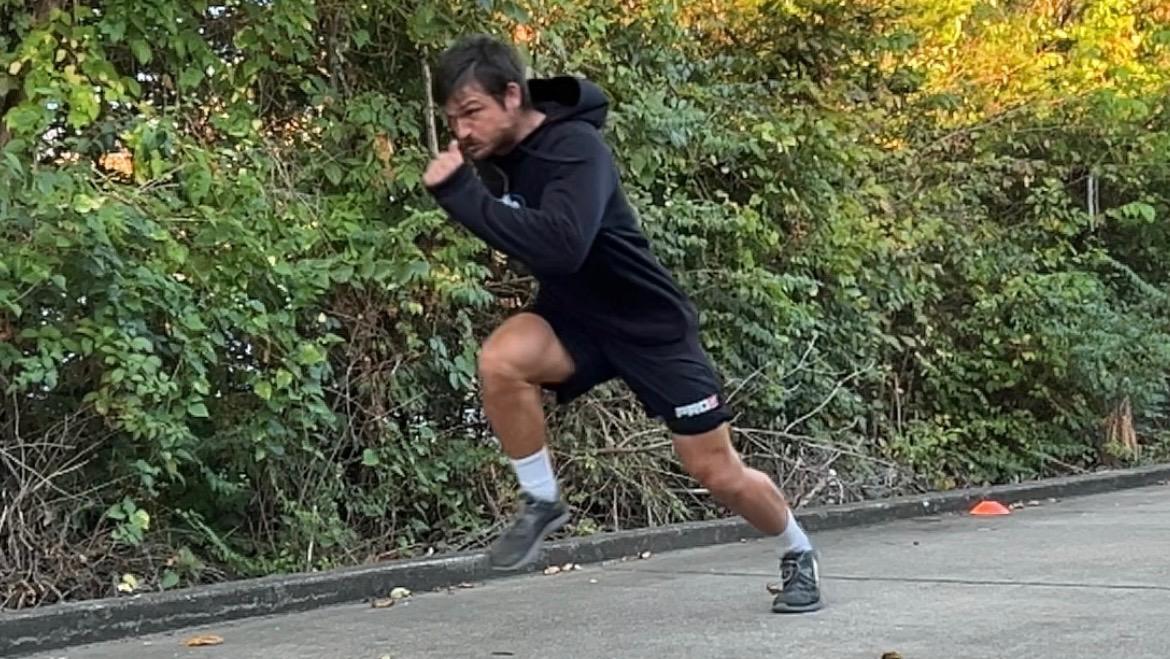
Why Fast Athletes Have Stiff Ankles
October 20, 2026 • Jared Kirven, PT, DPT, CSCS
When I tell athletes we want stiff ankles, they are often puzzled or ask why. They have heard “ankle mobility” their whole life, so when I say we want to train ankle stiffness, it often is accompanied by some explaining.
Both ankle stiffness and ankle mobility are good, which is exactly why this can be confusing. I want your ankle to move through a full range. I also want it to hold its shape when you hit the ground hard. Explaining the difference is most of this post.
What The Ankle Is Doing At Top Speed
Let's start with the basics. Your two calf muscles run down into your heel through the Achilles, and together they decide how much your ankle bends while your foot is on the ground. The two do slightly different jobs. The soleus, the deeper one, mostly holds you up. The gastrocnemius, the one you can see, helps push you forward.
Crotty and colleagues reviewed what that whole setup does in sprinters [1]. While you're accelerating, the ankle matters more than any other joint in your leg. It's the last thing between you and the ground, so every bit of force you make must pass through it to get there.
Then something flips once you reach top speed. The ankle becomes a net energy dissipater at that point, which is a technical way of saying it takes in more than it gives back. It has stopped being much of a motor. What it's doing instead is passing along the force your hips and knees already made, down through your foot and into the ground.
Think about a car. The engine makes the power, but that power only reaches the wheels through the driveshaft. A loose driveshaft means you lose some on the way. Your ankle is the driveshaft. So, at top speed the question isn't how much power your ankle makes. It's how much it loses in the handoff.
There's one more thing going on, and it's the reason sprinting isn't as exhausting as it probably should be. When your Achilles gets stretched quickly and then snaps back right away, it hands a chunk of that energy back to you for free. Your muscles never had to make it. The textbook name for this is the stretch shortening cycle. The catch is it only truly works when the stretch is quick. Sink down slowly, or sink too far, and that free energy becomes less.
Mobility And Stiffness Are Two Different Things
Range of motion is how much motion the ankle has available to it. Stiffness is how well it resists giving way once load goes through it. Two completely different qualities, measured differently and trained differently, and an athlete can have plenty of one and almost none of the other.
Drop a basketball on the gym floor and it comes back to you. Drop a beanbag from the same height onto the same floor and it stops dead. Same drop, same surface. What's different is what the object does with the energy. A compliant ankle is the beanbag. Force arrives, the ankle sinks into dorsiflexion, your foot stays on the ground longer, and the energy that should have come back out goes into the floor instead.
Yamazaki's group measured this directly in trained track and field athletes [2]. They tested ankle stiffness three ways: completely at rest, and then with the calf working at 20% and at 50% of a maximum contraction. Athletes with stiffer ankles at 50% had shorter ground contact times. At rest there was no relationship at all.
That last part is the piece I'd underline. The stiffness that tracked with performance was the stiffness they could generate, not the stiffness sitting in the tissue while they were lying on a table. Being tight doesn't make you fast. It usually just shrinks the range you can produce force in.
Kuitunen's group found the same relationship in actual sprinting years earlier, and the correlations between ankle stiffness and ground contact time were strong enough that it's held up as one of the more durable findings we have here. They also found something worth noting. As athletes ran faster, ankle stiffness climbed while knee stiffness stayed about the same. The ankle is where the body chose to make the adjustment.
So in practical terms, here's what a compliant ankle costs you. You spend longer on the ground, which caps how many steps you can take. And the energy the tendon should have handed back gets absorbed instead, so your muscles have to produce more of the next step from scratch. Neither of those shows up in the weight room. They show up as an athlete who looks like they're working harder than everyone else to go the same speed.
Which Is Why I Still Want The Range
If you can't get into dorsiflexion, you can't get into the positions where the calf and the foot produce force. Acceleration asks for a lot of shin angle over the foot. So does cutting, landing, and anything where the knee has to travel forward.
Range is the window. Stiffness is what you can do inside it. Opening the window wider doesn't help if nothing happens once you're there, and the best stiffness in the world is worth less if you can only access it in a narrow slice of motion.
How I Train A Stiffer Ankle
Two tools do most of the work for us here, with heavy calf strength sitting underneath both of them and a couple of rules covering how all of it gets dosed and tracked.
Overcoming Isometrics
Pushing as hard as you can into something that will not move. Burgess and colleagues ran six weeks of explosive isometric plantar flexion against six weeks of drop jumps [3]. Tendon stiffness climbed 61.6% in the isometric group and 29.4% in the plyometric group, and the difference between the groups wasn't significant. I lean on these because they let an athlete chase maximum intent without absorbing a landing, which matters even more with novice or return to sport athletes.
Four or five sets of three to five seconds, maximum intent, full rest between. Bent knee biases the soleus, straight knee biases the gastrocnemius, and I program both because they do different jobs.
Plyometrics, Starting Small
Pogos and low amplitude hops with the knee nearly locked, so the ankle does the work instead of handing it upstairs. Short contacts. Two feet before one foot, in place before traveling, low before high. That progression is usually slower than people want it to be.
The Strength Underneath Both
Loaded calf raises taken from full dorsiflexion to full plantar flexion, straight knee and bent knee. This is the part that protects the range while the rest of the program is chasing stiffness.
Two Rules I Follow
• Dose the plyometric's and intense work fresh. Early in the session, lower volume, high quality. This is nervous system work and intent is the entire point.
• Measure contact time. Put an actual number on it. A jump mat, a force plate, or slow motion video will all get you there, and reactive strength index, which is jump height divided by ground contact time, folds it into one figure worth tracking. Retest every few weeks. If contact time is coming down while jump height holds or climbs, the ankle is doing its job. If the number sits flat through a whole block, then the program needs to change, regardless of how good the work looks in the weightroom.
Bottom Line
Mobility and stiffness answer two different questions. Range is how much of the joint you can use. Stiffness is how much of the force you keep when you use it. Sprinting asks for both, and the second one gets trained far less often than the first.
Sources & Further Reading
Crotty ED, Furlong LAM, Harrison AJ. Ankle and plantar flexor muscle-tendon unit function in sprinters: a narrative review. Sports Medicine, 2024. https://link.springer.com/article/10.1007/s40279-023-01967-1
Yamazaki K, Sugibayashi T, Miyamoto N. Medial gastrocnemius stiffness contributes to active ankle joint stiffness and ground contact time in trained track-and-field athletes. European Journal of Applied Physiology, 2026. https://link.springer.com/article/10.1007/s00421-026-06377-5
Burgess KE, Connick MJ, Graham-Smith P, Pearson SJ. Plyometric vs. isometric training influences on tendon properties and muscle output. Journal of Strength and Conditioning Research, 2007. https://doi.org/10.1519/R-20235.1

Jared Kirven
KOA Sports Performance Founder and Coach